
Director's Order Creating the Ranegras Plain AMA
On October 27, 2025, following an informational public meeting on October 15, 2025, and a review of a technical memorandum issued by ADWR’s Chief Hydrologist, the Director of the Department of Water Resources issued an Order initiating the proceedings to designate the Ranegras Plain Groundwater Basin as a subsequent active management area (AMA) pursuant to A.R.S. § 45-412. On December 18, 2025, a public hearing was held to present factual data in ADWR’s possession as well as to receive public comments and evidence on whether the Director should designate the Ranegras Plain Groundwater Basin as a subsequent AMA (Ranegras AMA).
On January 9th , 2026, the Director issued a Findings, Decision and Order to designate the Ranegras Plain Groundwater Basin as a subsequent AMA (Designation Order), pursuant to A.R.S. § 45-414. The Department will publish a notice of the Designation Order in the Parker Pioneer and Yuma Sun once a week for two consecutive weeks. The date of designation, as defined in A.R.S. § 45-402, will be on the date the notice of the Designation Order is published for the final time.
Prohibition On Irrigation Of New Acres Is Permanently In Effect
Pursuant to A.R.S. § 45-416 irrigation users may irrigate only those acres of land within the Ranegras AMA which were legally irrigated at any time during the five years preceding November 5, 2025. Irrigate is defined in A.R.S. § 45-402 and means to apply water to two or more acres of land to produce plants or parts of plants for sale or human consumption, or for use as feed for livestock, range livestock or poultry.
Below is a list of additional requirements for the Ranegras AMA
Application for Certificate of Grandfathered Right
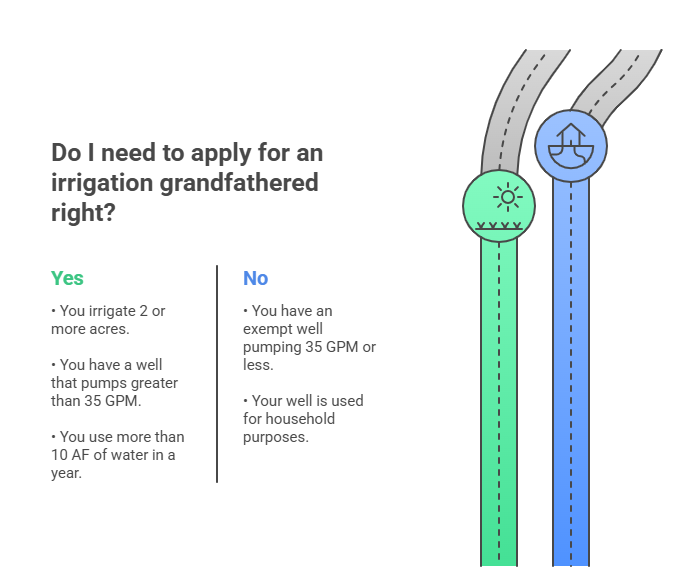
Individuals and entities seeking to claim a grandfathered right must apply for a certificate of grandfathered right no later than fifteen months after the date of the designation of the AMA, in accordance with A.R.S. § 45-476. A person who fails to apply for a certificate of grandfathered right within an active management area waives and relinquishes any right to withdraw or receive and use groundwater pursuant to a grandfathered right (A.R.S. § 45-477.01).
Mandatory Measuring and Reporting
Within AMAs, with a few narrow exceptions, persons withdrawing groundwater from non-exempt wells (wells having a maximum pump capacity greater than 35 gallons per minute) are required to measure their groundwater withdrawals with a measuring device or method that is approved by ADWR and must report the groundwater withdrawals to ADWR (A.R.S. § 45-604(A)). An approved measuring device must be installed by March 31, 2026.
ADWR has approved the use of devices and measuring methods other than the installation of meters in Arizona Administrative Code R12-15-903.
Persons withdrawing groundwater from exempt wells (wells having a pump with a maximum pump capacity of 35 gallons per minute or less that are used for a non-irrigation use) generally are not required to measure and report the groundwater withdrawals. Each person withdrawing groundwater from a non-exempt well shall file an annual water withdrawal and use report on a form prescribed by the Director no later than March 31 of each calendar year. The first annual report for the Ranegras Plain AMA shall be filed on or before March 31, 2027.
More information on establishment proceedings can be found here.
Anyone who would like updates about the Ranegras AMA can request to be added to an Interested Parties Email List by sending an email to Dennis Troutman, AMA Outreach Coordinator, at [email protected].
| Meeting Documents | Meeting Recording | ||
|---|---|---|---|
| Ranegras Plain AMA Information Session and Public Workshop | Thu, Mar 5 2026 | Meeting Recording | |
| Notice of Informal Public Meeting - Ranegras Plain Groundwater Basin | Wed, Oct 15 2025 | Meeting Recording |
On March 5, 2026, ADWR proposed a preliminary draft Management Goal for the Ranegras Plain AMA:
"The management goal of the Ranegras Plain AMA is to support the long-term economy and welfare of water users in the basin by prolonging the life of the aquifer through a reduction of groundwater overdraft by 50% in 50 years.
Informal Comments (MARCH 2026)
Participants in the March 5, 2026 public meeting were invited to provide informal comments on the draft Management goal during the meeting, and all others were invited to submit their informal comments in writing to the Department by March 31, 2026.
ADWR staff heard 8 comments directly related to the draft Management goal during the March 5 meeting and received 13 additional comments in writing by March 31. Memo, Ranegras Informal MG Comments Apr 2026 provides a summary of all comments and the next steps ADWR will take in the Ranegras Plain AMA.
Chance Whitworth | D. Viss Cattle | Fertizona-Compton AG Services | Fondomonte Arizona LLC | Gary Van Hofwegen | Hayday Farm Ventures | Helena Agri-Enterprises LLC | KP Venture Drilling & Pump | LM Hancock Farms LLC | McMullen Valley Water Conservation and Drainage District | Southwest Farm Services | Sprinkler World | Viss Hay Company LLC
1. What is an active management area, or AMA?
Active management areas, or AMAs, are groundwater basins within the state that are subject to certain statutory and administrative regulations regarding the withdrawal and use of groundwater, or in the case of the Santa Cruz AMA, the withdrawal and use of any water, other than stored water, withdrawn from a well. Currently, there are seven AMAs in Arizona – Prescott, Phoenix, Pinal, Tucson, Santa Cruz, Douglas, and Willcox.
2. What water management requirements are applicable in an AMA?
Each AMA has a management goal that guides water management in the AMA. If an AMA is designated in the Ranegras Plain groundwater basin, the management goal will be established by the director of ADWR after a public comment and a hearing. The director of ADWR is also required to adopt a management plan for each AMA. Each management plan is updated periodically and designed to assist the AMA in reaching or maintaining its management goal. Management plans for six AMAs can be viewed on ADWR’s website.
AMAs are also subject to assured water supply requirements for new subdivisions. Within an AMA, a developer of a proposed subdivision (six lots or more) must have a 100-year assured water supply in order to obtain plat approval and offer lots for sale. A developer may demonstrate an assured water supply by either (1) obtaining a commitment of water service from a water provider that has been designated by ADWR as having an assured water supply, or (2) obtaining a certificate of assured water supply from ADWR by demonstrating that the subdivision will have a 100-year assured water supply.
3. What land may be irrigated in an AMA?
In a subsequent AMA, only acres of land that were legally irrigated at any time during the five years preceding the formal initiation of proceedings to establish the AMA may be irrigated with any water, except that acres of land that were not irrigated during the relevant five-year time period may be irrigated:
- With groundwater, if ADWR determines that substantial capital investment (SCI) has been made to bring the land into irrigation within a particular window of time.
Individuals and entities are required to apply for a certificate of grandfathered right no later than fifteen months after the designation of an AMA, per A.R.S. § 45-476.
4. Who is allowed to withdraw groundwater in an AMA?
Within an AMA, a person must have a right or permit to withdraw groundwater from a well having a pump with a maximum capacity greater than 35 gallons per minute (“non-exempt well”).
Generally, a person may withdraw groundwater for non-irrigation use from a well having a pump with a maximum pump capacity of 35 gallons per minute or less (“exempt well”) without a right or permit. However, there are some limitations on the use of exempt wells within AMAs, including:
- Only one exempt well may serve the same use at the same location.
- Withdrawals from an exempt well for a commercial purpose are limited to 10 acre-feet per year.
5. Are groundwater users required to meter and report groundwater withdrawals?
Within AMAs, with a few narrow exceptions, persons withdrawing groundwater from non-exempt wells (wells having a maximum pump capacity greater than 35 gallons per minute) are required to measure their groundwater withdrawals with a measuring device and method that is approved by ADWR and must report the groundwater withdrawals to ADWR.
Persons withdrawing groundwater from exempt wells (wells having a pump with a maximum pump capacity of 35 gallons per minute or less that are used for non-irrigation use) are generally not required to measure and report groundwater withdrawals.
6. How does someone obtain a right or permit to withdraw groundwater in an AMA?
A right or permit is required to withdraw and use groundwater in an AMA. Depending on the history of use and the type of use, a water user may be eligible for a grandfathered right, a service area right, or a groundwater withdrawal permit.
Individuals and entities seeking to claim a grandfathered right (rights based on historic pumping) are required to apply for a certificate of grandfathered right no later than fifteen months after the designation of an AMA, per A.R.S. § 45-476.
The three types of grandfathered rights are:
- Irrigation grandfathered rights, or IGFRs, allow the holder to irrigate acres of land that had been irrigated within the five-year period preceding the call for the election. Land without an IGFR may not be irrigated with groundwater. An IGFR may not be sold apart from the associated land.
- Type 1 non-irrigation grandfathered rights are associated with land permanently retired from farming and converted to a non-irrigation use (e.g., building a new industrial plant). Like an IGFR, this right may be conveyed only with the land. The maximum amount of groundwater that may be pumped each year using a Type 1 right is three acre-feet per acre, though it may be less.
- Type 2 non-irrigation grandfathered rights can only be used for non-irrigation purposes. The right is based on historical groundwater pumping for non-irrigation use and equals the maximum amount pumped in any year in the five-year period preceding the designation of the AMA. Examples of non-irrigation uses include industry, livestock watering, and golf courses. Type 2 rights are the most flexible because they may be sold separately from the land or well. In addition, the owner of a Type 2 right may, with ADWR approval, withdraw groundwater from a new location within the same AMA. It is possible to lease a portion of a Type 2 right, but if the right is sold, it cannot be divided; instead, the entire right must be sold.
Service area rights authorize cities, towns, private water companies, and irrigation districts to withdraw groundwater for delivery to customers within their service area for municipal and industrial uses.
Groundwater withdrawal permits allow pumping in specific circumstances, usually for non-irrigation uses, set forth in statute, for a limited period of time. Examples include the following:
- Hydrologic testing permits
- Poor-quality groundwater withdrawal permits
- Temporary permits for electrical energy generation in emergency situations
- Mineral extraction and metallurgical processing permits
- Drainage and dewatering permits
- General industrial use permits
7. What if I have made investments to begin irrigation, but did not start irrigating before restrictions were in place?
For an area that was not previously an INA, acres of land will be deemed to have been in irrigation if “substantial capital investment” (SCI) was made during the five years before the initiation of proceedings to establish the AMA “for the subjugation of such land for an irrigation use including on-site irrigation distribution facilities and a well or wells the drilling and construction of which were substantially commenced before the date of the notice of the initiation of designation procedures.” A.R.S. § 45-452(G)(1).
Property owners who believe they qualify for consideration of SCI may apply to ADWR, and ADWR will evaluate each application on a case-by-case basis.
8. If an AMA is designated, will groundwater users have to pay a withdrawal fee?
Under the current statutes, there is no requirement for persons withdrawing groundwater in a subsequent AMA (any AMA designated after 1980) to pay a groundwater withdrawal fee. Other fees may apply within a subsequent AMA, including, for instance, a water quality assurance fee applicable to persons who own a Type 1 or Type 2 non-irrigation grandfathered right or who hold a groundwater withdrawal permit for beneficial use. See A.R.S. § 45-616.
9. If an AMA is designated, how will the management goal and management plan be established?
The director of ADWR will establish management goal for the AMA. A.R.S. § 45-569(A). The director of ADWR must promulgate an initial management plan for the AMA within two years after the designation of the AMA. The director may provide for subsequent management plans to be promulgated during the time set for achieving the management goal. A.R.S. § 45-569(B).
Before adopting a management goal or a management plan, the director will conduct a public hearing on the proposed goal and proposed management plan per A.R.S. § 45-570. Anyone will have an opportunity to provide oral or written comments for or against the adoption of the management goal or plan.
10. How will water duties be determined if an AMA is designated?
Within AMAs, individual water duties are established based on the amount of water reasonably required to irrigate the crops historically grown on a given farm unit, and the method for calculating water duties is established as a part of each management plan for the AMA.
11. If an AMA is established, what limitations on drilling, deepening, or replacing an exempt well would apply?
Exempt wells are wells used for non-irrigation use and have a pump capacity of 35 gallons per minute or less.
Within an AMA, limitations on the use of exempt wells include:
- Only one exempt well may serve the same use at the same location.
- Withdrawals from an exempt well for a commercial purpose are limited to 10 acre-feet per year.
Additionally, drilling of exempt wells would continue to be subject to certain statewide requirements, including:
- Filing a notice of intention to drill with ADWR Using a licensed well driller
- Compliance with construction standards established by ADWR
- Filing completion reports with ADWR
- For exempt wells that are located on a parcel of land of five or fewer acres that will be used for a domestic purpose, submitting a site plan that, among other things, demonstrates that the well will not be drilled within 100 feet of a septic tank or sewer system and includes approval by the county health authority.
12. What are the well-spacing requirements within AMAs?
In AMAs, non-exempt wells (including deepening or replacement of existing wells) require the approval of the director. In addition to the statewide requirements for wells, those applications are subject to rules governing the location of new wells and replacement wells to “prevent unreasonably increasing damage to surrounding land or to other users from the concentration of wells.” A.R.S. § 45-598(A). Those rules (R12-15-1301, et seq.) may be viewed at: Arizona Administrative Code
13. If an AMA is designated, will there be an opportunity for people to challenge applications for grandfathered rights, including those based on substantial capital investment?
All applications for grandfathered rights must be submitted within 15 months of the designation of the AMA. After that deadline, the director of ADWR would establish a directory of all applications received for a certificate of grandfathered right and provide a notice of the availability of the registry. Any resident of the groundwater basin may file a written objection to any application and request a hearing on the application within 180 days. Objections may be made only on the basis that the information in the application is incorrect or insufficient to issue a certificate. Procedures for holding the hearings are set forth in A.R.S. § 45-480.
14. If an existing well with the capacity to pump more than 35 gallons per minute is used to water livestock before the creation of an AMA, could that well continue to water livestock if an AMA is created?
Generally yes, if the individual applies for and receives the applicable grandfathered right. In this instance, the applicable right is called a Type 2 grandfathered right. See FAQ No. 6 for a summary of the types of grandfathered rights within an AMA.
15. If an existing well with a maximum capacity of no more than 35 gallons per minute is used to water livestock prior to the creation of an AMA, could that well continue to water livestock if an AMA is created?
Generally yes. Wells that have a maximum capacity of no more than 35 gallons per minute and that are used for non-irrigation purposes may be exempt from AMA requirements. See FAQ No. 4 for other limitations that apply to whether a well is exempt.
16. What are the transportation requirements for groundwater withdrawn within the Ranegras Plain Groundwater Basin and exported to Phoenix or Tucson?
Generally, if a basin is not an AMA, groundwater may not be transported away from the basin, with certain limited exceptions. Under statute, specific basins including Harquahala, Butler Valley, and McMullen Valley may be used to transport groundwater to the initial AMAs, like Phoenix or Tucson. The Ranegras Plain basin is not one of the basins under statute from which groundwater may be transported to an initial AMA.
If a basin is an active management area, groundwater may be transported away from the basin in some circumstances but only if it is withdrawn pursuant to a grandfathered right or a service area right. It would also be subject to limitations on use and payment of damages depending on the type of right.
17. Would the creation of an AMA disqualify a farmer who grows and exports products like cotton, cows, cheese and alfalfa pursuant to an Irrigation Grandfathered Right from growing these products within the AMA and then exporting those products outside the AMA?
No, the creation of an AMA would not disqualify a farmer who grows and exports products like cotton, cows, cheese and alfalfa pursuant to an Irrigation Grandfathered Right from growing these products within the AMA and then exporting those products outside the AMA.
While the exportation of raw groundwater is subject to transportation limitations, these limitations do not apply to a farmer who is growing crops with groundwater and then exporting those crops outside the AMA. This is true regardless of whether an AMA is created.
18. Where can I learn more about the AMA and grandfathered rights?
More information can be found at ADWR's Active Management Area
